
Foundational Papers: Understand Where the Science Really Starts
Foundational Papers: Understand Where the Science Really Starts
The Problem With Starting From the Middle
Most researchers enter a research field mid-progression. You read only the papers your advisor recommended, you inherit the studies cited in the grants, you analyse the reviews that shaped your understanding of a pathway or a mechanism ... But somewhere upstream of all of that, there are a handful of papers that changed everything. Papers that defined how a receptor is understood, how a disease model was built, how an entire methodology became standard.
Missing those papers doesn't mean your process or research are wrong. It means your reasoning is incomplete. And in biomedical research, incomplete reasoning has consequences, especially for grant applications, hypothesis design, or even how highly your work is positioned in the field.
This is why we built Foundational Papers. Not to surface more literature. To surface the right literature: The studies your entire research context traces back to, whether you've read them or not.
What Are Foundational Papers?
Foundational Papers are the landmark studies that shaped the field you're researching. They are identified not by keyword matching or recency, but by co-citation analysis: BioSkepsis AI maps how often papers are cited together across your search results and surfaces the ones that appear at the center of that citation network.
Every research field has them. A paper that first characterized a receptor's binding kinetics. A clinical trial that changed treatment guidelines. A mechanistic study that reframed how a pathway was understood. These papers are rarely the newest ones in your results, but they are the ones everything else is built on.
BioSkepsis surfaces them directly within the context of your research query, so you're not just seeing what's current, you're seeing what's foundational to it.
Why Does This Matter for Biomedical Researchers?
Biomedical literature doesn't exist in isolation. Every paper you read exists in relationship to others building on prior findings, refining earlier conclusions, sometimes overturning them entirely. Understanding that relationship is what separates a surface-level literature review from a scientifically grounded one.
The retrieval of Foundational Papers is particularly valuable for:
- Principal Investigators building grant rationales who need to demonstrate command of the field's scientific lineage.
- Early Career Researchers who may have deep familiarity with recent literature, but less exposure to the work that preceded it.
- Biotech and Pharma Researchers who need to anchor mechanistic or translational claims in well-established science.
- Lecturers and Educators who want to structure teaching around the studies that genuinely had a valuable input in shaping a field.
- Systematic Reviewers who need to ensure their review doesn't inadvertently omit the papers everything else references.
What Happens When You Select a Foundational Paper?
When you select a foundational paper within BioSkepsis AI, you receive a structured, full-context summary that breaks down the study across the dimensions that matter most for your research.
You'll see the experimental models the study was conducted in whether that's a specific organism, a cell line, a cohort, or a model system, alongside its key findings of the paper that actually demonstrated within the context of your query. The summary also surfaces the key findings of what the original authors acknowledged they could not resolve, so you're not inheriting a paper's limitations without knowing they exist. And critically, it maps the downstream citation trail of the studies that followed, refined, challenged, and/or built directly on the original conclusions, giving you a clear picture of how the science evolved after that paper was published.
Foundational papers are not a static abstract. They are a structured scientific briefing on a paper's place in the field designed to help you understand not just what the paper said, but what it started.
How to Use Foundational Papers in BioSkepsis AI
Step 1: Run Any Research Query
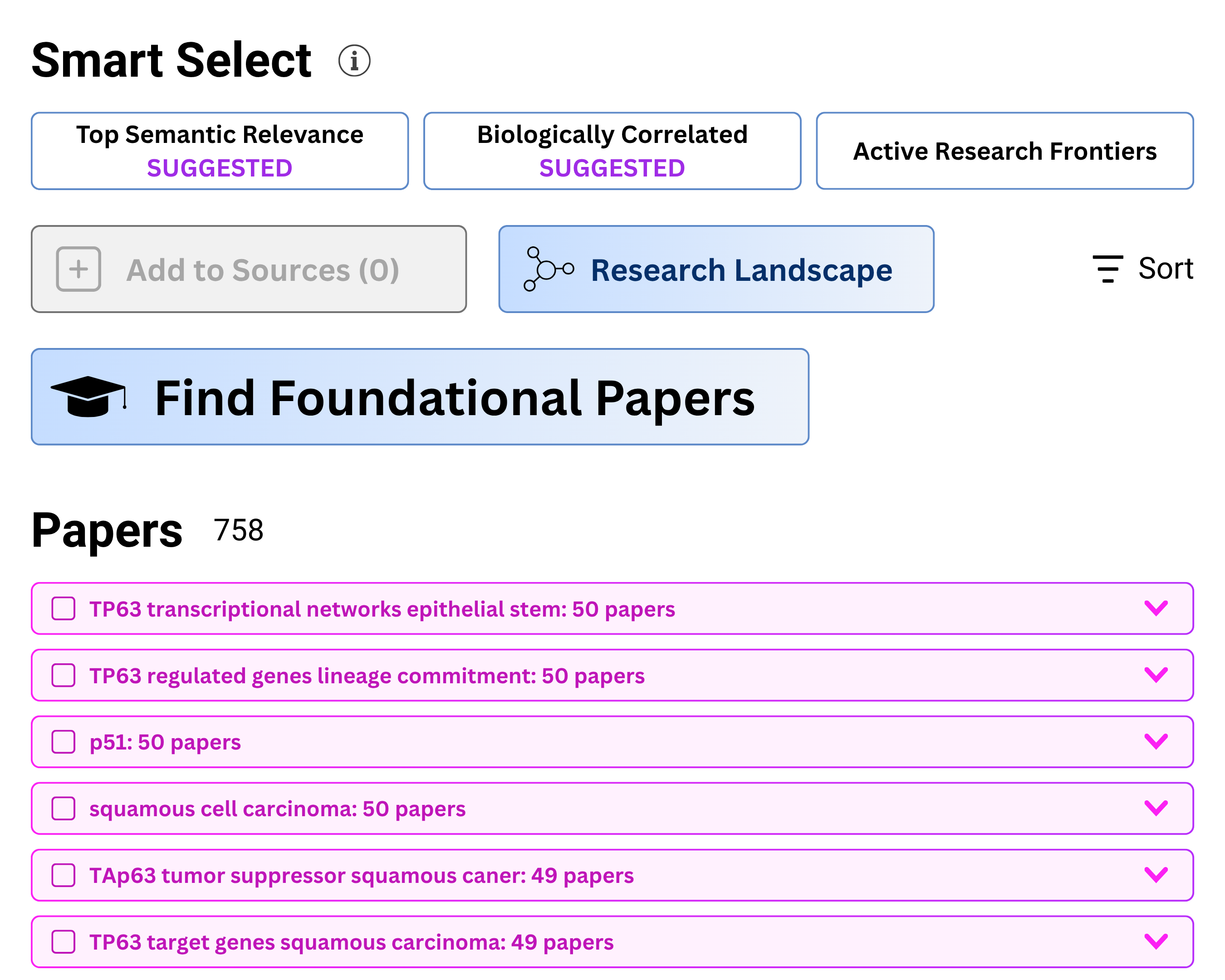
Foundational Papers works within any active BioSkepsis research session. You can find it on the right-side panel of the screen after every query, no matter the type of query.
Step 2: Open the Foundational Papers
Once the papers are loaded, click the Foundational Papers button within your research session. BioSkepsis will surface the papers that appear most consistently at the center of the citation network across your results set, these are your foundational papers, ranked by their centrality to your specific query.
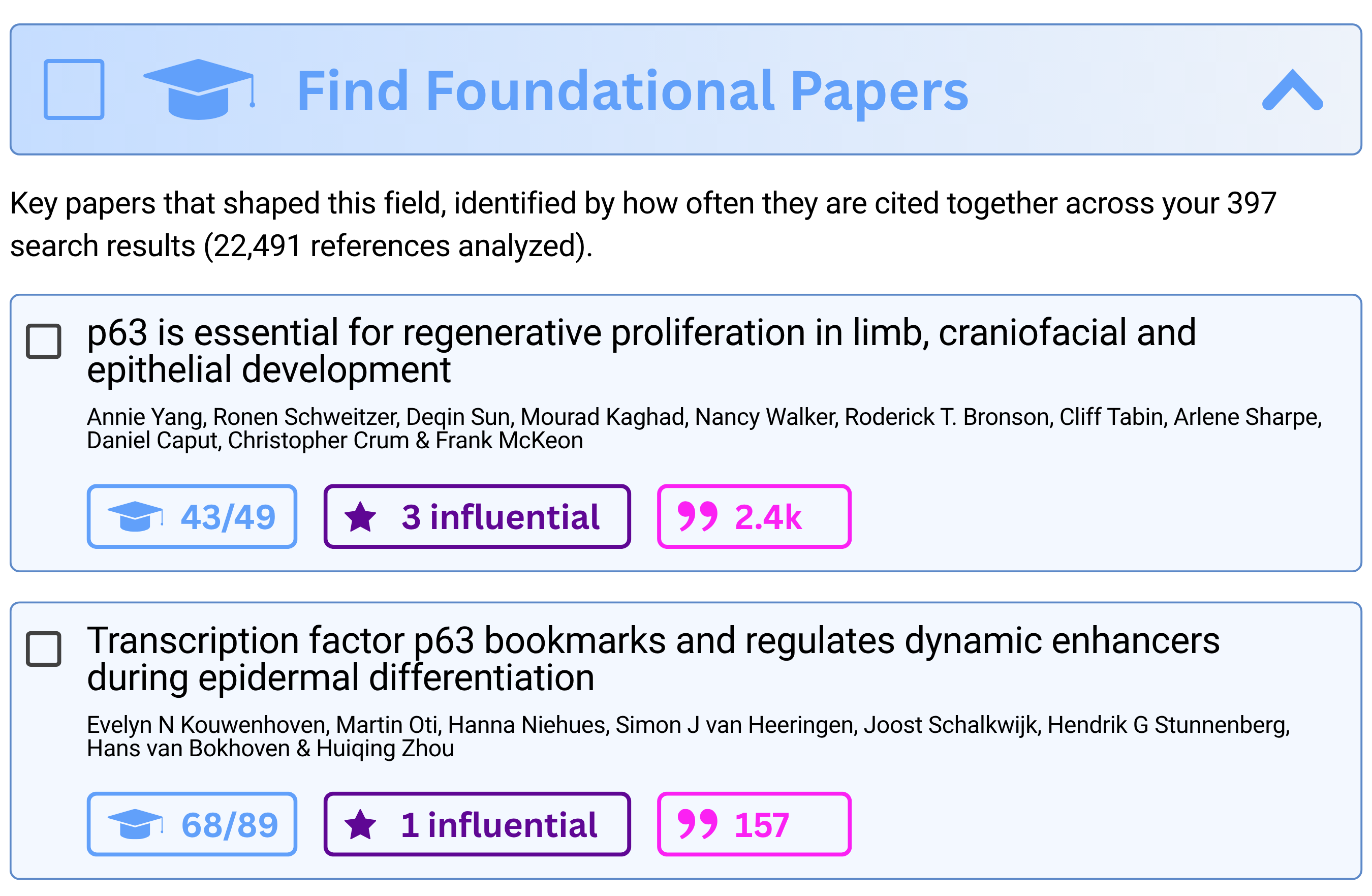
Each entry shows the paper title, authors, publication year, and an indication of its citation weight relative to your results. You don't need to import these papers for them to appear, BioSkepsis identifies foundational studies even if they fall outside your original library collection.
Step 3: Get the Full Structured Breakdown
Click on any Foundational Paper title to open its full-context summary. This is where BioSkepsis generates the complete structured analysis: experimental models, key findings, limitations, and downstream citation mapping. You can read through the summary directly within the platform.
Step 4: Ask Follow-Up Questions
After reviewing the structured summary, you can select either all Foundational Papers or select individually which ones you would like to add to your sources. Then, ask BioSkepsis to go deeper on a specific finding, compare the foundational paper's conclusions against more recent studies, explore how the methodology evolved in subsequent work, or explain how the paper connects to your specific research question. The foundational paper becomes a live reference point within your research session.
How Foundational Papers Fits Into Your Full BioSkepsis AI Research Workflow
Foundational Papers works alongside BioSkepsis AI's full research toolkit:
- Use Smart Select first to filter your imported or searched papers by Top Semantic Relevance, Biologically Correlated, or Active Research Frontiers. Then, run Foundational Papers on your filtered set for more precise results.
- Use Research Landscape to visualize how your foundational papers relate to the broader field and to each other.
- Add Foundational Papers to Sources in your chat and ask BioSkepsis to compare them against more recent literature, generate hypothesis frameworks, or summarize the field's scientific evolution.
- Export structured summaries, citation maps, and insights directly from your session.
Your Research Doesn't Start with the Newest Paper
It starts with the paper that made the newest papers possible.
Foundational Papers gives you that starting point as an active part of your research session. Whether you're writing a grant, designing an experiment, or preparing a lecture, knowing where the science actually began means your reasoning is built on something solid.